
Private Family Tours in Guatemala, with Optional Belize Extensions
Private family tours in Guatemala give families a more thoughtful way to explore the country, with a journey designed around pace, comfort, curiosity, cultural respect, and the real needs of children, parents, grandparents, and extended family members.
Some families need slower mornings. Some children learn best when they can move, ask questions, and pause. Teenagers may want deeper stories, photography, wildlife, food, or a little more independence. Grandparents may need shade, shorter walks, smoother transfers, or quiet time between larger days.
Martsam designs private family journeys through Guatemala with this rhythm in mind: your children’s ages, your family’s pace, your comfort needs, your interests, and the level of guidance that helps the country feel understandable rather than overwhelming.
Belize can be added when reef, beach, rainforest, wildlife, or a gentler Caribbean ending improves the journey. It should support the Guatemala experience, not rush it.
Family Travel Documentation & Planning Considerations
When traveling internationally with children, preparation is important.
Depending on nationality, airline policies, transit countries, and immigration regulations, additional documentation may sometimes be requested when minors travel with only one parent, grandparents, guardians, or other relatives.
To help ensure a smooth travel experience, families should verify current requirements before departure and carry any necessary authorization letters or supporting documents.
Our travel specialists are happy to provide general guidance during the planning process, helping families prepare for their journey with confidence.
https://www.gov.uk/foreign-travel-advice/guatemala/entry-requirements
https://www.travelbelize.org/getting-here/visas-and-immigration/
Private Family Travel Designed Around Your Family’s Rhythm
Family travel is not only a question of where to go. It is a question of timing, energy, attention, meals, rest, curiosity, and comfort.
A good itinerary protects the mood of the journey. It leaves space for a child to ask why a volcano smokes, for grandparents to enjoy a view without feeling hurried, and for parents to know that the day can adjust if the family needs a quieter afternoon.
For Martsam, private travel is not about excess. It is about care. Private guides, private transportation, thoughtful route design, and flexible pacing help families experience Guatemala with less friction and more presence.
Why rhythm matters more than doing everything
The strongest family journey is not the one with the longest list of stops. It is the one whose pace allows each person to stay engaged.
That may mean visiting an archaeological site earlier in the day, choosing a hotel that makes rest easy after a transfer, shortening a market visit with younger children, or giving teenagers enough context to understand why a place matters.
When the rhythm is right, learning feels natural. When it is wrong, even a beautiful day can become tiring.
Why Guatemala Works for Private Family Travel
Guatemala offers families a rare combination of culture, archaeology, nature, history, wildlife, lakes, volcanoes, food, textiles, and living traditions within one carefully planned journey.
The country can be especially rewarding for families who want their children to learn through experience: walking through a colonial city with a guide who explains its layers, crossing Lake Atitlán by boat, listening to stories of Maya history at Tikal, or understanding how a textile tradition carries knowledge through generations.
Guatemala is not a destination to rush. It becomes family-friendly when each region is chosen for the right reason and connected with realistic travel days.

Antigua, Lake Atitlán, Tikal, Petén, and the Highlands
Antigua Guatemala often works well as a gentle beginning. It is walkable, historic, visually rich, and close to workshops, food experiences, coffee farms, and volcano views that can be adapted to different ages.
Lake Atitlán invites a slower family rhythm. Boat rides, village visits, textiles, cooking, scenery, and quiet time by the water can help families balance learning with rest.
Tikal and Petén bring the Maya world into the forest. For families, this can be powerful when the visit is planned around heat, shade, walking distances, wildlife, timing, and the ability of a guide to make archaeology understandable.
The Guatemalan Highlands can add markets, landscapes, farming communities, artisan knowledge, and deeper cultural context when the family has enough time and the right preparation.
Culture, nature, archaeology, and guided learning
Family travel in Guatemala should not treat culture as decoration.
Markets are places of work and exchange. Textiles carry identity, memory, and skill.
Maya heritage is not only ancient history; it continues through languages, communities, foodways, ceremonies, knowledge, and daily life.
Nature also deserves care.
Lakes, forests, volcanoes, wildlife habitats, and protected landscapes are not only settings for family photographs.
They are living systems that children can learn to observe, respect, and help protect.
The role of a good guide is to connect these meanings with the age and curiosity of the family.

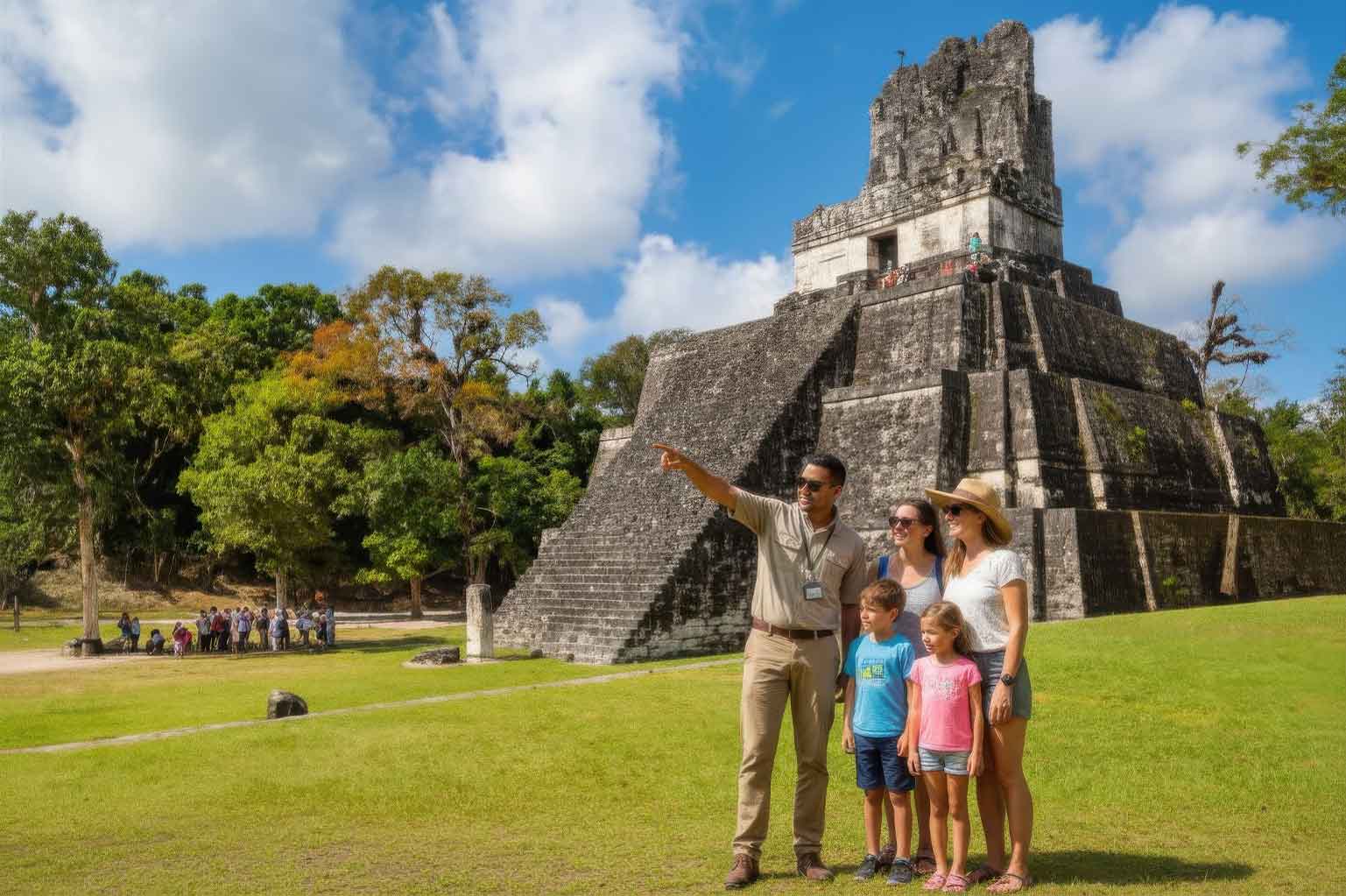
What Martsam Designs Into Every Private Family Journey
A private family tour is shaped by many decisions that travelers may not see at first: the hour a visit begins, the route chosen for a transfer, the guide matched to the family, the hotel location, the amount of walking, the meal timing, and the space left for rest.
These details matter because parents are not simply choosing destinations. They are choosing whether the journey will feel manageable, meaningful, and well cared for.
Guide fit and age-appropriate interpretation
Family guides need more than knowledge. They need timing, patience, warmth, and the ability to translate complex places into stories that children, teenagers, parents, and grandparents can all enter.
At Tikal, that may mean turning architecture, forest sounds, and wildlife into a shared learning experience. In Antigua, it may mean explaining history without overwhelming younger travelers. Around Lake Atitlán, it may mean helping families approach local life with context and respect.
Private transportation and route logic
Private transportation gives families control over practical details that shape the day: comfort, timing, luggage, stops, snacks, bathrooms, motion sickness, and rest.
Route logic matters. A well-designed journey avoids unnecessary backtracking, considers road conditions and transfer length, and gives families enough energy to enjoy the places they came to see.
Hotels selected for family comfort
Family-friendly accommodation is not only a room with enough beds. It may mean a quieter location, room configurations that work for grandparents and children, food flexibility, space to rest, easy movement through the property, or a pool or garden that gives the family somewhere to settle between activities.
Comfort should support presence. The right hotel helps the family recover well enough to stay curious the next day.
Flexible pacing and downtime
Private planning allows the itinerary to include space for real family life. A child may be tired. A grandparent may prefer a slower morning. Weather may change. The family may discover that a quiet afternoon by the lake is more valuable than adding another stop.
Flexibility cannot remove every travel challenge, but it can make the journey more humane.
Tell Us How Your Family Travels
Share your children’s ages, who is traveling, your preferred pace, activity level, comfort needs, mobility considerations, interests, dietary needs, and whether Belize is a must-have, a possibility, or something you would like Martsam to evaluate.
How We Adapt the Journey by Age and Generation
A meaningful family journey does not ask every traveler to experience the day in the same way.
Private travel makes it possible to design shared experiences while respecting different ages, energy levels, and needs.
Young children and school-age travelers
Younger travelers usually benefit from shorter visits, movement, stories, hands-on learning, familiar meal rhythms, and enough breaks to keep the day from becoming too demanding.
The itinerary may include chocolate or cooking experiences, gentle nature walks, boat rides, wildlife observation, shorter museum or market visits, and guide-led stories that make history feel approachable.
Teenagers
Teenagers often appreciate more independence, deeper conversations, photography, food, wildlife, archaeology, soft adventure, and guides who do not simplify too much.
A good private journey can give them substance: the scale of Tikal, the social history of Antigua, the living culture around Lake Atitlán, or the environmental importance of forests, lakes, and reefs.
Grandparents and multigenerational families
Multigenerational travel succeeds when comfort and inclusion are planned from the beginning.
Walking distances, heat, stairs, hotel access, rooming needs, shaded pauses, transfer length, and optional activity variations all matter.
The goal is not for everyone to do exactly the same thing every hour. The goal is to create a journey where the family can share what matters and still respect individual limits.
Family Experiences in Guatemala
Every Martsam family itinerary is custom designed, but many families are drawn to Guatemala because it offers learning in many forms: through place, conversation, food, landscape, wildlife, and human knowledge.
Maya archaeology and living cultural context
Tikal, Iximché, Quiriguá, and other archaeological sites can be deeply engaging for families when they are guided with care. Children may remember the height of a temple or the sound of monkeys in the trees, but the deeper value comes when they understand that Maya history is connected to living communities today.
Visits to markets, artisan spaces, kitchens, farms, or textile workshops should be approached with preparation, permission, and respect. Families learn more when they understand how to listen.
Nature, wildlife, volcanoes, lakes, and soft adventure
Guatemala can offer active days without forcing every family into the same level of intensity. Depending on age, fitness, weather, and comfort, a journey might include volcano viewpoints, boat rides, kayaking, wildlife observation, rainforest walks, horseback riding, coffee farms, or quieter time in nature.
Nature experiences should help children notice relationships: forest and wildlife, lake and community, volcano and landscape, reef and marine life when Belize is included.
Hands-on learning with context
Chocolate workshops, cooking experiences, weaving demonstrations, food markets, photography, and family-friendly cultural activities become more meaningful when they are not treated as entertainment alone.
The best hands-on moments help children understand where knowledge comes from, who preserves it, and why respect matters.
When Belize Becomes the Right Family Extension
Belize can be a beautiful addition after Guatemala for families who have enough time and want a different closing rhythm: reef, beach, snorkeling, rainforest, wildlife, islands, marine life, or a broader Mundo Maya route.
The best Guatemala and Belize family journey is not created by adding another country automatically. It is created when Belize gives the family something the Guatemala itinerary cannot provide on its own.
Add Belize when it improves the journey
Belize may be right when your family wants Caribbean rest after cultural and archaeological travel, when children are excited by reef and marine life, or when the trip length allows a smooth transition without making the whole journey feel rushed.
For some families, Belize becomes the exhale at the end of the journey.
Choose Guatemala only when depth is better than adding a second country
For shorter trips, Guatemala alone may be the stronger choice. A deeper itinerary with better pacing often creates more connection than a faster two-country route.
Martsam can help you decide whether Belize belongs in your itinerary or whether Guatemala deserves the full attention of the family.
If Belize is right for your family, explore our Belize vacation packages and sample itineraries for ideas on combining rainforest, reef, coast, and time to slow down.
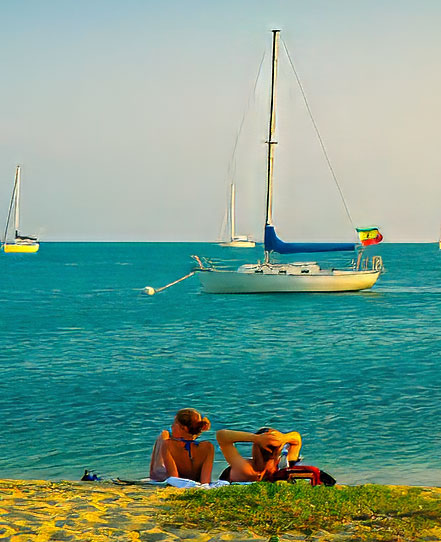
Ask Whether Belize Fits Your Family Journey
Not every family needs a two-country itinerary. Tell us your trip length, pace, children’s ages, and priorities, and we will help evaluate whether Belize adds balance or unnecessary movement.
Responsible Family Travel with Cultural Respect
Travel can teach children how to move through the world with curiosity and care. That lesson begins with the way a journey is planned.
Martsam believes families should experience Guatemala with respect for people, place, culture, and nature. Communities are not attractions. Traditions are not performances. Nature is not a backdrop.
A thoughtful family itinerary prepares travelers to ask better questions, listen with humility, request permission when appropriate, respect photography boundaries, support local knowledge, and understand that every visit takes place within a living community and environment.
Culture is not decoration
Guatemala’s cultural richness should be approached through context. Children can learn that language, food, textiles, markets, ceremonies, music, farming, and daily life are part of living identities, not objects arranged for visitors.
Private guidance helps families enter these experiences with more awareness.
Nature is not a backdrop
Forests, lakes, volcanoes, wildlife habitats, and reef ecosystems deserve attention and protection. Family travel can help children understand why conservation matters, especially when guides explain the relationship between place, wildlife, community, and responsibility.
What to Share Before We Design Your Family Journey
The more we understand your family, the better we can design the journey. Helpful details include:
- Children’s ages and number of travelers.
- Whether grandparents or extended family are joining.
- Travel dates, trip length, and flexibility.
- Preferred pace: active, balanced, slow, or mixed.
- Primary interests: archaeology, wildlife, food, textiles, markets, volcanoes, photography, lake time, soft adventure, beach, reef, rest, or cultural learning.
- Comfort expectations: boutique hotels, lodges, villas, rooming needs, pool or rest needs, food flexibility, and privacy.
- Mobility, health, altitude, heat, walking, or accessibility considerations.
- Dietary needs and allergies.
- Places the family hopes to include or avoid.
- Whether Belize is essential, optional, or something you would like us to assess.
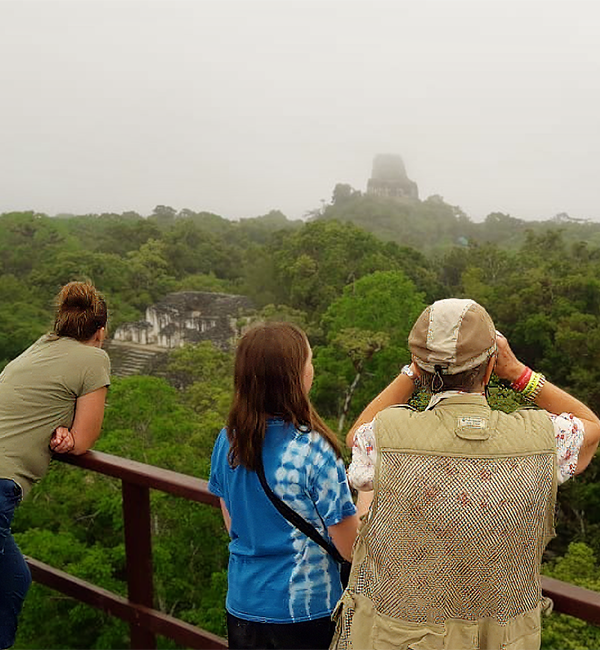
Sample Family Journey Ideas
- 7-Day Guatemala Family Journey
A gentle introduction focused on Antigua and Lake Atitlán.
- 10-Day Guatemala Family Journey
The strongest Guatemala-only family arc, adding Petén and Tikal.
- 12-Day Guatemala + Belize Journey
A Guatemala-first journey with Belize as a reef, beach, rainforest, or Caribbean rest extension.
Planning a Guatemala Family Trip?
Start with the Family-Friendly Principles
Before choosing destinations, it helps to understand what makes a private Guatemala journey work for real families: pace, guide fit, transfer logic, hotel comfort, cultural context, and the ability to adjust when energy changes.
For families still deciding whether Guatemala is the right fit, our planning guide explains how Martsam defines a truly family-friendly private tour in Guatemala.
Plan a Private Family Journey with Martsam
A well-designed family journey begins with a conversation. Tell us who is traveling, what your family hopes to understand, how active you want the trip to feel, and what kind of comfort helps everyone stay present.
Martsam will help shape a private Guatemala family journey around your actual rhythm, with Belize added only when it genuinely improves the experience.
🗓️ Free Consultation | 🌎 Local Experts | 📞 Support 24/7
Start Planning Your Family Journey
Frequently Asked Questions
Is Guatemala a good destination for families?
Guatemala can be deeply rewarding for families when the itinerary is designed around pace, private transportation, guide quality, hotel comfort, age-appropriate activities, and downtime. It is especially strong for families interested in culture, archaeology, nature, lakes, volcanoes, markets, wildlife, and educational travel.
What ages are best for a private Guatemala family tour?
Different ages can enjoy Guatemala when the route is planned carefully. Young children usually need shorter visits and more breaks. School-age children often enjoy stories, workshops, wildlife, and hands-on learning. Teenagers may appreciate deeper history, photography, food, adventure, and more complex guide conversations.
Are Martsam family tours private or shared?
Martsam family journeys are custom-designed private tours. This allows for adaptable timing, private transportation, guide attention, and the ability to shape each day around your family’s pace and interests.
Can grandparents join a Guatemala family tour?
Yes, multigenerational journeys can work very well when walking demands, transfer length, hotel comfort, shade, rest time, mobility needs, and optional activity variations are planned from the beginning.
Is Guatemala safe for family travel?
No destination should be described as risk-free. Martsam helps families make informed choices about routes, transportation, accommodations, guides, activities, timing, and comfort level. Families should also review current travel advisories and personal documentation requirements before departure.
How much walking is involved at Tikal or archaeological sites?
It depends on the site and route. Tikal is large and can involve heat, uneven paths, stairs, and significant walking. A private guide can shape the visit around age, energy, timing, shade, and the family’s level of interest.
How many days do families need in Guatemala?
Many families benefit from 7 to 10 days for a well-paced Guatemala journey. Shorter trips may focus on Antigua and Lake Atitlán. Longer trips can add Tikal, Petén, the Highlands, volcanoes, wildlife, or more downtime.
When should we add Belize to a Guatemala family tour?
Belize can be added when the family has enough time and wants reef, beach, snorkeling, rainforest, wildlife, or a slower Caribbean ending after Guatemala. It should improve the rhythm of the journey rather than make the trip feel rushed.
When is Guatemala alone the better choice?
If time is limited, a deeper Guatemala itinerary may be more rewarding than adding a second country too quickly. The goal is a better family rhythm, not more stops.
Can the itinerary be adjusted during the trip?
Private travel allows more flexibility than fixed group departures. Adjustments may depend on logistics, weather, guide availability, hotel policies, and safety considerations, but the itinerary should be designed with room for family reality.
What documents may be required when traveling with children?
Requirements vary by nationality, airline, transit country, destination, and guardian situation. Families traveling with minors should verify current requirements before departure and carry any necessary authorization letters or supporting documents.
.
How does Martsam choose family-friendly guides and hotels?
Martsam considers guide fit, age-appropriate interpretation, route judgment, comfort, room configuration, location, food flexibility, quiet, pool or rest options, ease of movement, and each family’s specific needs.