Guatemala Important Holidays & Festivities

Guatemala Important Holidays | Culture, Traditions & Festivals:

The cultural treasures of Guatemala are unique and the most vibrant in Central America, highlighting its holidays and festivities.

Each town in the country celebrates holidays with different social, cultural, and sports events. Many are similar, but two must-sees are Fiesta de Todos Santos Cuchumatan: October 21 to November 1 and Fiesta de Chichicastenango: December 13 to 21.

All Saint’s Day In Todos Santos Cuchumatan

November 1 is one of the most important days in Guatemala. On this day, the Day of the Dead is celebrated. In addition, cemeteries are visited and decorated to remember loved ones.

It is a blend of ancient pagan beliefs and Catholic traditions brought by the conquerors in the 16th and 17th centuries.
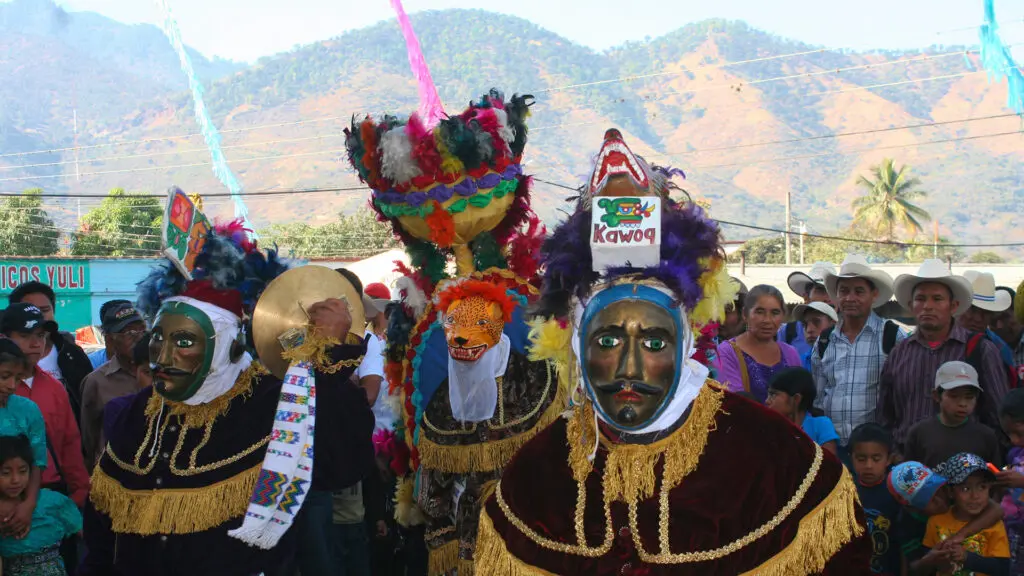
Rabinal Patronal Fest – January 25

Commemoration to the ancestors

In the prehispanic world, they had specific days to remember their ancestors. For example, in the t story of the Mayan calendar, known as a Tzolkin, they celebrated an event named Watzakib Batz. In addition, it was easier to communicate with the dead’s world during this period.

There are other representations of death in different Mayan sites, such as El Baul in Santa Lucía Cotzumalguapa, indicating the reverence of the Mayan civilization to death.

Unique fusion

After the conquest, Catholic priests were responsible for the reorganization of the natives. Monks put the name of a saint to each town to entrust them under their protection and indoctrinate the catholic tradition to natives.

The native, meanwhile, acquired the Christian events but adapted them to their environment, resulting in a series of syncretic rituals that were sustained over time and took a unique and unparalleled enhancement.

In the commemoration of saints and the dead, the celebration took a particular enhancement due to the prehispanic custom of devoting a few days to sharing with the ancestors.

The acceptance of the Christian faith gave rise to the belief that the dead can revisit their loved ones in the world of the living, and thus rituals unique to Guatemala arose.

These include the preparation of altars for loved ones, the food called fiambre, kites, horse races, among many other events that make this season a colorful social and cultural manifestation.

These traditions and festivities have drawn the attention of travelers worldwide, and yearly, they take the time to go to Guatemala, matching up their vacations to Guatemala to live an authentic cultural experience in the enigmatic Mayan world.

Celebration of Santo Tomas, Chichicastenango

The festivities begin with local indigenous groups praising God and traditions in December. Then, take your time to appreciate the Palo Volador, where local people, hanging from a rope, swing around a pole within the main square.

The Giant  Kites Festival of Santiago & Sumpango, Sacatepequez

Date of celebration, November 1 and 2 Currently, two categories of kites have been established. Those are up to six meters in height, and the biggest is about 20 meters.

Two months before the event, the persons were organized into 10 to 15 people groups. Then, a committee organizes the activity and consensus about the kites and the designs and materials to use.

The themes were chosen and not made for a competition in the past. The designs are created by experienced hands, especially young people who have maintained the existing tradition in the municipality.

The Feast: The expected day

On November 1, the cemetery is filled with many people who come to admire the creative art of the inhabitants, organizers, judges, and a large number of tourists.

Accompanied by fireworks and music, colorful kites fill the sky decorated with different motifs. So the tradition lives on, The tradition lives on, even though the designs have evolved and acquired other characteristics.

The indigenous people prepare a visit to their dead relatives. First, they decorate the graves; people arrive with food, the deceased’s favorite, which they share with the family.

They make a prayer that expresses their affection to their loved ones. Then, they cover the ground with flowers. Finally, it shows the family’s art; It is a particularly colorful and traditional moment to commemorate those who have already left.

The bond with the other world

Kites are believed to have been brought to Guatemala by Franciscan priests. They discovered them during evangelization in Asia.

Various historians of colonial plazas refer to them as kites. Native adopters began using them with tissue paper, reed, and glue; they began to blow them away with the help of strong November winds. Kites are an ideal means of communicating with the dead.

During these two days, they “have permission” to revisit the world of the living. Thus, people gathered in cemeteries fly kites dedicated to their loved ones. Tradition says they can’t do flight tests. These only need to be flying on a specific date to communicate the message. Oral tradition indicates that this colorful festival began at the end of the 19th century.
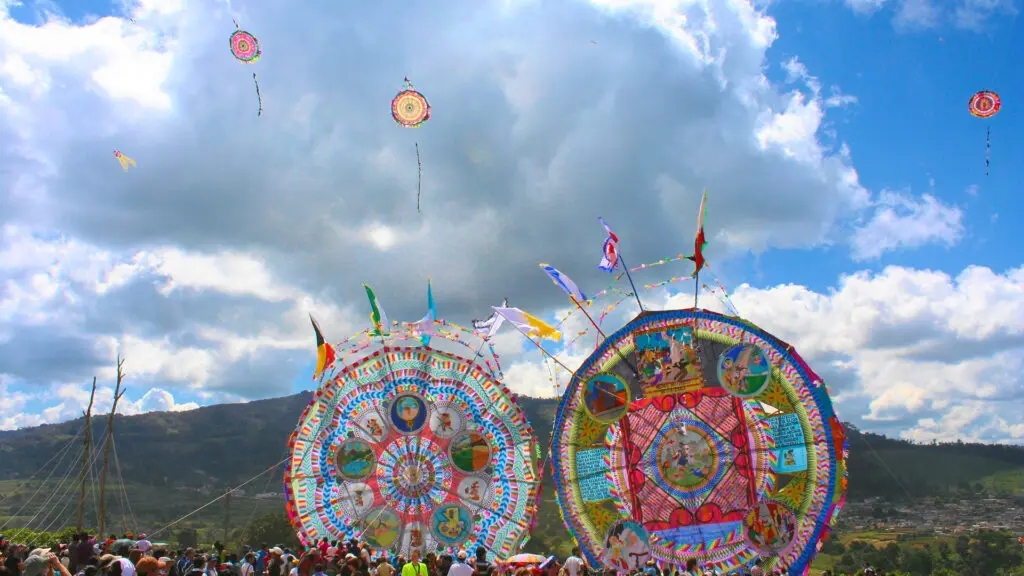
Giant Kites

Rabin Ajau Fest

The national folk festival of Cobán, Alta Verapaz, is a cultural event that brings together delegations that represent the indigenous beauty of all the Mayan ethnic groups currently existing in Guatemala.

Its fundamental objective is the exchange of cultural imprints of each region and the election and investiture of the National Indigenous Queen or Rabin Ajau (Daughter of the King).

It is celebrated on the occasion of the patron saint festivities of the City of Cobán, from August 1 to 6 of each year, in honor of Santo Domingo de Guzmán.

It is an event of typical costumes and various folk dances that surprise visitors, taking indelible memories of contact with ethnic groups of the ancient Mayan culture.

The Paa’bank  Cultural Festival

One of the most important celebrations of native traditions in Guatemala is the traditional Paabanc dance. This festivity is commemorated by the Qeq’chis people who dress in traditional attire.

This is one of the festivities that is most frequently observed in Las Verapaces, in the Q’eqchi group, since some are for the wake of the saint’s day (Rub’el Nimq’e) and the same on the day of the festivities (Li Nimq’e) and sometimes occurs in the transmission or delivery of charges and their reception, which may be from the superior stewardship of a brotherhood from which other small ones emerge, such as the Covers, Fireworks Games and the candles.

It is there where we observe in a ritual form of reverence, humility, and harmony, in a balanced society that delivers a position to be able to administer it well; That is the Q’eqchi society, where the moral and spiritual values ​​that keep these people latent start to continue cultivating yesterday, which is the school of the present.

That is why, as a cultural act, after the event of the Election and Coronation of the National Indigenous Queen “Rabin Ajaw,” this party is held in the Ermita de Santo Domingo, where religious ceremonies, presentation of folkloric dances and traditional music with harp, shawm, adufe, marimba, and tamborón.

An essential part of this festivity is the typical food. The famous Cak’ik is made, representing our region’s gastronomic culture and the favorite Boj drink. In addition, fireworks are burned to brighten up the event.
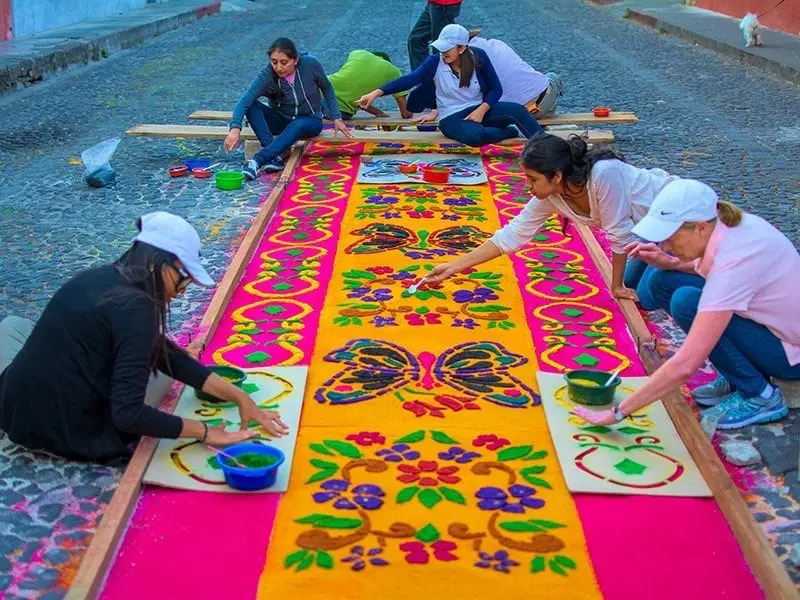
Sawdust Carpet

Holy Week in Guatemala

Holy Week is one of the most vibrant periods to travel to Guatemala. Each of the native communities carries out religious and folkloric traditions. Among the best places to see this event is Antigua Guatemala. Locals take part in a procession through the street carrying statues of Christ that represent the station of the cross.

They are colorful processions that march on a carpet of sawdust vividly placed in the town’s streets. Processions take place throughout the week and run through the entire town. Other towns with traditional parades are Huehuetenango and Totonicapán. The churches of Guatemala City also have processions.

Where to Stay in Belize: Choose the Region First

Before comparing hotels, decide which part of Belize should receive your time. The location of each stay determines which experiences fit comfortably into the day.

Cayo District for Rainforest, Caves and Maya Sites

Stay in or around San Ignacio when Xunantunich, Caracol, cave experiences and the western rainforest are priorities.

A town hotel provides convenient access to restaurants and local life. A jungle lodge offers more privacy, nature and time within the forest. The right choice depends on whether you want to explore every day or enjoy the property between guided activities.

Cayo also provides the most practical base for a day at Tikal, although the international border adds time and formalities.

Ambergris Caye for Reef Access

Ambergris Caye suits travelers who want several days on the water and convenient access to the Belize Barrier Reef.

San Pedro has a wider choice of restaurants, services and boat operators than Belize’s quieter coastal areas. It works particularly well when snorkeling or diving is central to the trip.

The island is more active than secluded. Travelers looking for greater privacy should consider where on Ambergris Caye they stay, not only the hotel category.

Hopkins or Placencia for the Southern Coast

Hopkins and Placencia offer a different Caribbean finish.

Hopkins provides access to Garifuna cultural experiences, nearby nature reserves and the southern reef. Placencia combines a longer beach setting with restaurants, resorts and excursions toward Monkey River and offshore cayes.

Neither should be added simply as another stop. Choose between them according to the atmosphere, activities and accommodation style you prefer.

Can You Combine the Jungle and Beach?

Yes. A journey can begin in the Cayo District and finish on an island or the southern coast.

Seven days can work when the route remains simple. Nine or ten days provide more time for both regions and reduce the pressure created by transfers.

The best combination is not automatically Cayo and Ambergris Caye. Hopkins or Placencia may suit travelers who prefer the southern coast, while Ambergris Caye provides easier access to several well-known reef areas.

Belize Reef

Three Sample Belize Itinerary Routes

These routes show what each trip length can hold without turning every day into a transfer. They are starting points, not fixed departures.

5 Days: Choose the Interior or the Coast

Interior route

  • Day 1: Arrive and transfer to the Cayo District

  • Day 2: Xunantunich and a local cultural or culinary experience

  • Day 3: Choose Caracol, ATM Cave or another full-day activity

  • Day 4: Nature, a shorter cave experience or time at the lodge

  • Day 5: Return to the airport

Coastal route

  • Day 1: Continue to Ambergris Caye, Hopkins or Placencia

  • Day 2: Private reef or snorkeling excursion

  • Day 3: A second water activity, nature excursion or open day

  • Day 4: Flexible coastal day

  • Day 5: Return to the airport

Five days do not leave much room for recovery if weather disrupts a reef day. Keeping one day flexible can make the trip more enjoyable.

7 Days: Cayo and One Coastal Base

  • Day 1: Arrive and transfer to the Cayo District

  • Day 2: Xunantunich and the surrounding area

  • Day 3: Choose Caracol, ATM Cave or another full-day experience

  • Day 4: Transfer to Ambergris Caye, Hopkins or Placencia

  • Day 5: Reef excursion

  • Day 6: Nature, culture, another water activity or time to rest

  • Day 7: Departure

This route works best when you select one major inland activity and one coastal destination. Adding every well-known site would make the week unnecessarily rushed.

10 Days: Cayo, Maya Sites and the Caribbean

  • Day 1: Arrive and transfer to the Cayo District

  • Day 2: Xunantunich and a cultural or culinary experience

  • Day 3: Caracol or ATM Cave

  • Day 4: A second inland experience, a lodge day or a visit to Tikal

  • Day 5: Transfer to the coast or Ambergris Caye

  • Day 6: Private reef excursion

  • Day 7: Wildlife, culture or another day on the water

  • Day 8: Flexible coastal day

  • Day 9: A final excursion or time without a fixed schedule

  • Day 10: Departure

Ten days provide more choice without requiring every day to remain full. Tikal can replace one inland day, while a broader Guatemala journey requires additional nights.

Tikal National Park

When Should a Belize Itinerary Include Guatemala?

Belize and Guatemala work well together when archaeology and Maya heritage are important to the journey. The amount of Guatemala you include should depend on the time available.

Adding Tikal from Belize

Tikal can be visited while staying in western Belize. However, the day includes an international border crossing and considerable travel time.

This option suits travelers who want to see Tikal but cannot add several nights in Guatemala. It works best when the surrounding Belize itinerary remains focused.

Another option is to stay in Guatemala’s Petén region. This allows more time at Tikal and can also accommodate Yaxha before continuing into Belize.

A Wider Guatemala and Belize Itinerary

A journey including Antigua Guatemala, Lake Atitlán, Tikal, the Cayo District and the Caribbean normally needs about 13 days.

The route can move from Guatemala’s highlands to the Maya lowlands, cross into western Belize and finish beside the reef. This sequence avoids unnecessary backtracking.

With fewer days, choose either Guatemala’s highlands or a longer stay in Belize. Trying to include every region in ten days weakens the time available for both countries.

Frequently Asked Questions About Planning a Belize Itinerary

How Many Days Do You Need in Belize?

Five days suit one main region. Seven days can combine the Cayo District with one coastal base. Nine or ten days allow more time for both without filling every day.

Is Seven Days Enough for Belize?

Yes, when the route remains focused. Choose one inland base and one coastal destination. Limit the number of full-day excursions and avoid adding several regions simply because they appear close on a map.

Can You Visit the Jungle and Beach in One Belize Trip?

Yes. The Cayo District can be combined with Ambergris Caye, Hopkins or Placencia. Seven days can support this route, while nine or ten days provide a more relaxed balance.

Should You Stay on Ambergris Caye, in Hopkins or in Placencia?

Choose Ambergris Caye for convenient reef access and a more active island setting. Hopkins combines the southern coast with Garifuna culture and nearby nature. Placencia offers a longer beach setting, restaurants, resorts and access to southern marine excursions.

Can a Belize Itinerary Include Tikal?

Yes. Tikal can be visited from western Belize, although the day includes an international border crossing. Staying in Guatemala’s Petén region provides more time when Tikal and Yaxha are central to the journey.

What Is the Best Time to Visit Belize?

December through April generally brings the driest weather and the most dependable conditions for reef activities. The wetter months can bring fewer visitors and lower rates, but rain and storm disruption become more likely.

For broader seasonal and destination information, read our Belize destination guide.

Turn Your Belize Itinerary Into a Private Journey

These sample routes provide a realistic starting point. The final sequence depends on your flight times, hotel availability, preferred activities and the pace that suits the people traveling.

Tell us your dates, number of days and whether the rainforest, Maya sites, reef or Caribbean coast matters most. Martsam’s Belize team can then arrange the hotels, private transportation, guides and experiences around your plans.

Explore our Belize vacation packages or contact us to discuss a private itinerary.

Martsam Journal

Martsam Journal

Travel Insights from Guatemala, Belize & the Mundo Maya

Explore thoughtful travel insights from Martsam Travel, including Guatemala and Belize guides, cultural context, family travel advice, nature experiences, and private journey planning.